Classroom Seating Arrangements: Ideas & Strategies
The seating arrangement is one of the most effective — and most underrated — tools in any classroom. It shapes noise levels, attention, and group dynamics. Here's an overview of proven layouts, strategies for restless classes, and how to put the right plan in place fast.
The classic layouts compared
Traditional rows
The classic: all eyes on the board, few side conversations, ideal for tests and direct instruction. Downside: group work means rearranging furniture.
U-shape (horseshoe)
Everyone sees everyone, discussions flow naturally, and you can reach every student quickly. But it needs space — and invites conversations across the room.
Table groups
Perfect for cooperative learning and station work. The price: some students sit with their backs to the board, and the baseline noise rises. Here, who sits with whom is everything.
Seating arrangements for restless classes
With lively classes, the layout matters less than where individual students sit:
- Separate the talkers: disruptive students never side by side — and ideally not directly behind each other.
- Use the edges: edge seats have fewer neighbors and fewer distractions.
- Front and center: students near the teacher's desk act up less — and students with focus issues benefit from being close to the board.
- Calm anchors: focused students placed between lively ones often have a balancing effect.
Each of these strategies can be written down as a rule — and that means it can be automated.
How often should seats change?
Many teachers switch at the semester or after breaks. More frequent changes (say, monthly) mix the class better socially but cost planning time every single time — unless the new chart takes one tap.
Putting it into practice digitally
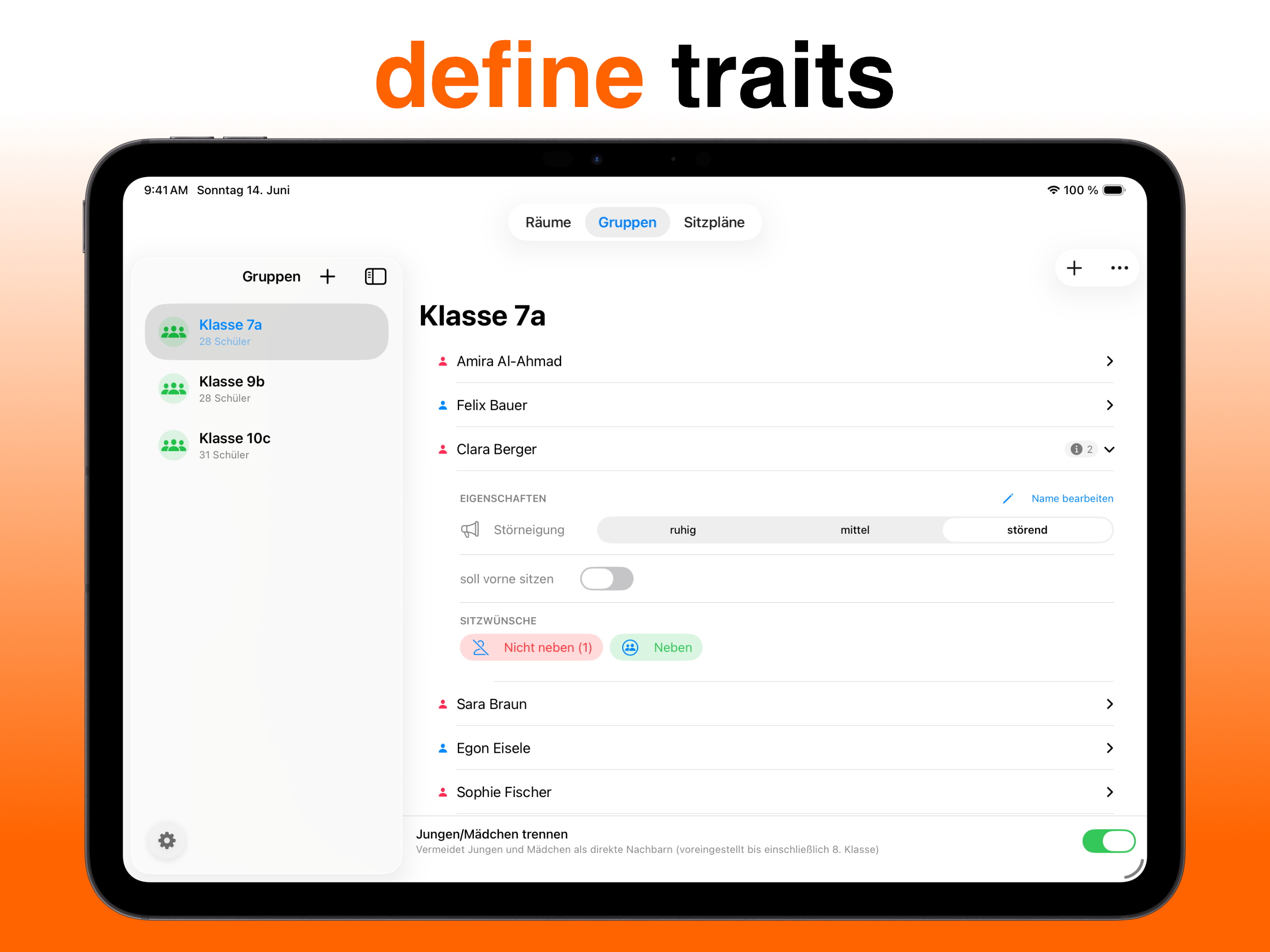
With the Platzwahl app you rebuild your classroom as a grid (rows, U-shape, table groups — any layout), store rules per student such as disruption level or preferred neighbors, and let the app compute the optimal chart. A score shows how well all rules are met. New month, new arrangement? One tap.

Get Platzwahl for free
Free download · iPhone & iPad · iOS 17+ · No account needed
 Discover Platzwahl →
Frequently asked questions
What's the best seating arrangement for a restless class?
There's no universal answer, but proven principles: separate disruptive students and seat them at the edges or up front, use calm students as buffers — and enforce the chart consistently. Traditional rows offer the least surface for distraction.
Is there a random generator for seating arrangements?
Yes — but pure randomness ignores conflicts and needs. Platzwahl combines both: fresh variety with every computation, but always within your rules.
Can I save different arrangements for the same room?
Yes. In Platzwahl you create as many rooms and classes as you like, each with its own charts — rows for test days, table groups for project phases.